The honest answer to “is pre-construction still worth it?” in 2026 is: not the way it was worth it in 2021. The flip-on-assignment era is over. But the same conditions that ended it, a sales slump, a glut of finished units, builders cutting prices and governments cutting taxes, have created the best buying conditions for new homes in the GTA in more than a decade. Here is the case, with the numbers, and the risks you still have to manage.
1. New-home prices have come down to meet buyers
The GTA new-condo market hit a 35-year low in early 2026: 246 sales across the whole region in the first quarter and not one new project launch (Toronto Life). Builders responded the only way they could. Projects that launched at $800,000 are relisting remaining suites under $600,000, and unsold completed inventory held by developers reached a record 5,001 units in the second quarter (Urbanation). On the low-rise side, the benchmark price of a new single-family home fell 14.6% year over year to $1,248,866 in August (BILD/Altus).
For a buyer that is the opposite of a problem. You are negotiating with builders who need sales, on product that was priced for a different market.
2. The HST relief is a 13% price cut on top
For agreements signed between April 1, 2026 and March 31, 2027, the full 13% HST comes off a new home priced under $1,000,000, up to $130,000, and it applies to every buyer and to long-term rental purchases. On a $600,000 condo that is $78,000; on a $900,000 townhome, $117,000. No resale home gets this. We break down the bands and the timing rules in our HST guide.
Put the two together and the premium that new homes carried over resale, 43% on a per-square-foot basis in mid-2026 according to Urbanation, shrinks sharply for homes under $1,000,000. That premium was the main argument against buying new. For twelve months it is largely gone.
3. Nothing is being built, which is the setup for the next shortage
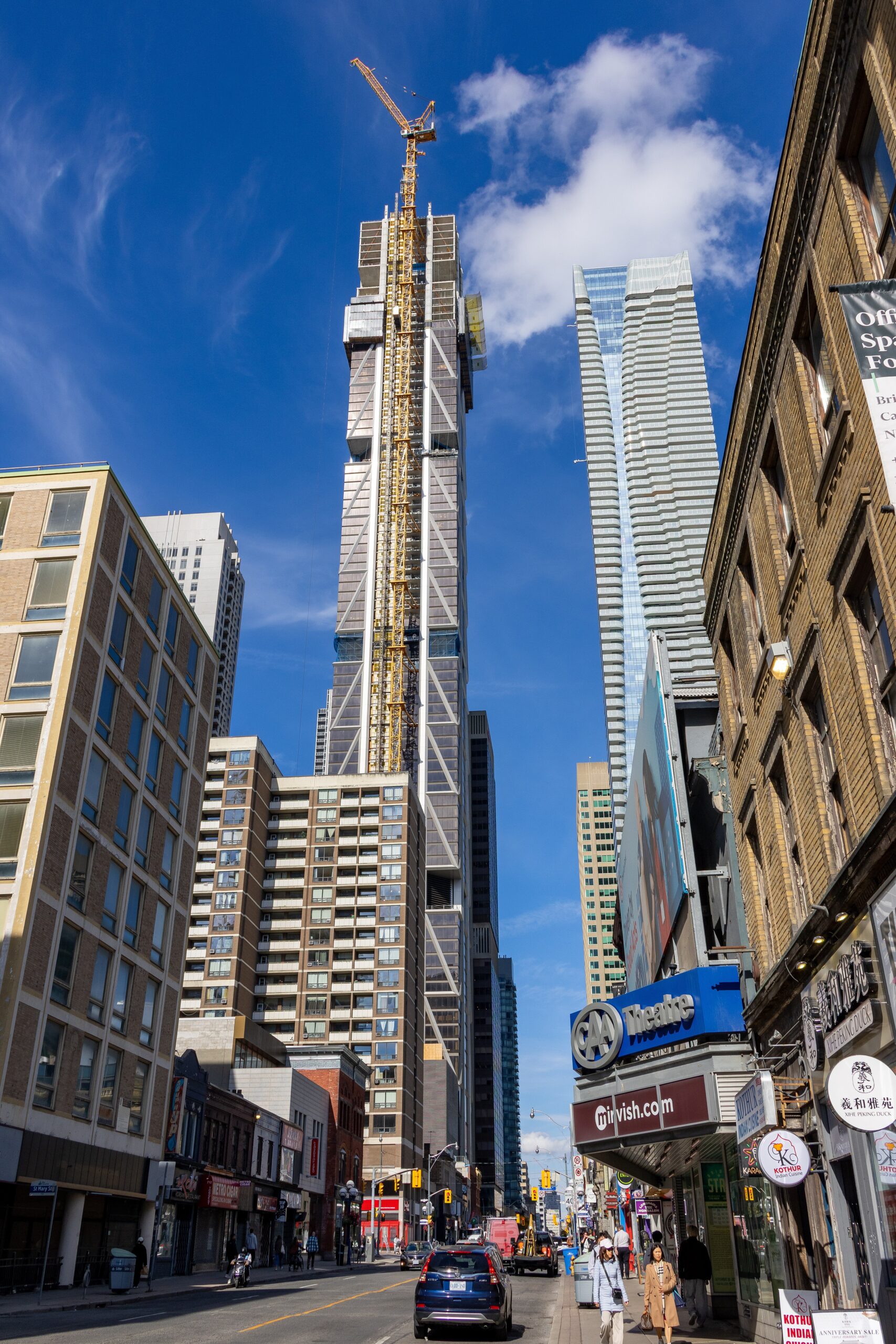
Zero condo launches in the first half of 2026. Pre-construction sales down 80% to 50 units in a quarter. More than 11,600 units cancelled since 2024. Those numbers describe the supply pipeline for 2029 to 2032 going quiet. The GTA is still adding population, and the units that will be ready in 2029 are, for the most part, the ones selling today in projects that are already under construction. Buying into a funded, under-construction project now means owning completed housing at the moment the pipeline behind it is thinnest.
4. Builders are competing on terms, not just price
In 2021 a 20% deposit over a year was standard. In 2026 we are seeing:
- Fixed-dollar deposits: $60,000 over 330 days or $85,000 over 510 days on townhomes from $549,900 at Lakeview Village in Mississauga (DECO/OPUS, September 2026 launch).
- Extended deposit schedules on condos of 15% over 1,100 days or more.
- Capped development charges, free assignment, decor credits, free appliances and “mortgage-free” occupancy programs on near-complete buildings.
- 0% mortgage programs for the first years after closing on at least one downtown tower.
Every one of these is worth real money and none of them existed in a seller’s market. Read our deposit guide for how the structures work.
5. Low-rise is quietly strong
The condo slump gets the headlines. Single-family new-home sales in the GTA ran 47% above the ten-year average in August 2026, the fifth straight month above average (BILD/Altus). Freehold towns and singles in Oshawa, Markham, Aurora and Mississauga are launching, selling and closing, and with the benchmark price down 14.6% more of them sit under the $1,000,000 and $1,500,000 HST thresholds than at any point since 2020.
6. Two ends of the market are moving
Developers told Real Estate Magazine that new condo sales under $500,000 rose 64% while luxury sales above $2,000,000 rose 9%, and the middle stalled (REM). That tells you where to look: entry-level product that end users and rental investors can carry, and large suites for downsizers who are selling a house. Small one-bedroom investor units between $1,000,000 and $2,000,000 are the segment to avoid.
What still has to go right
Pre-construction is a contract to buy something that does not exist yet, and 2024–2026 proved what happens when that goes wrong. Manage these before you sign:
- Builder strength. Prefer builders with projects already under construction and financed. Ask who the construction lender is and whether the project has a Tarion registration. Cancellations happen to projects that never got financed.
- Completion timing. The HST relief has construction deadlines. A tower promising 2030 occupancy is a different proposition from a townhome finishing in 2027.
- Your own carrying costs. Model the mortgage at today’s rates plus a buffer, not the rate the sales office quotes.
- The agreement. Use the ten-day cooling-off period on new condos to have a lawyer check assignment rights, closing adjustments and development-charge caps.
- Resale and rental value. Buy the layout and location you could sell or rent in a weak market, not the cheapest unit on the price list.
We wrote a longer piece on the risks of pre-construction that is worth reading alongside this one.
The bottom line
In 2026 you are not buying pre-construction to flip an assignment. You are buying a new home from a motivated builder at a repriced level, with 13% of the price removed by the government, on deposit terms designed for buyers rather than speculators, into a supply pipeline that is about to go quiet. For an end user who wants a new home, or an investor who will hold and rent, that combination will not be on the table after March 31, 2027.
See which projects fit this case
Every project in our database shows the entry price, occupancy date, deposit structure and incentives, and we flag the ones that sit inside the HST timing rules. Tell us your budget and we will send the current price lists and floor plans.
Chat with an expert on WhatsApp — an expert will reply within minutes — or browse every project with current pricing and use the form below to get price lists and floor plans.
Sources: Urbanation, Q2 2026 GTHA condo market; Toronto Life; BILD/Altus, August 2026 new home sales; Real Estate Magazine; Baker Tilly on the HST relief.
This article is general information from a real estate brokerage, not tax or legal advice. Rebate amounts, eligibility and timing rules are set by the federal and Ontario governments and can change; confirm your situation with the builder and a tax professional before you sign. Prices quoted are “from” prices published by builders or their co-operating brokerages on the dates noted and are subject to change.