A first-time buyer signing for a new home in Ontario in the next six months has more government help available than any buyer in Canadian history. Two overlapping HST rebates, a tax-free savings account built for a down payment, a $60,000 RRSP withdrawal, land transfer tax refunds and 30-year insured mortgages. Most of it stacks. Here is the full list, what each is worth, and the order to use them in.
Use our HST rebate calculator — enter a price, your plans and occupancy date and see the relief, the timing fit and the first-time buyer alternative in seconds.
1. The 2026 HST relief: full 13% off under $1,000,000
For purchase agreements signed between April 1, 2026 and March 31, 2027, the full 13% HST comes off a new home priced up to $1,000,000, with a $130,000 cap from $1,000,000 to $1,500,000 and a phase-down to $24,000 above $1,850,000. It applies to every buyer, so you do not need to prove first-time status for this one. On a $650,000 condo that is $84,500. Full details in our HST guide.
2. The first-time buyer HST rebate: the backstop that runs to 2030
Separately, the federal and Ontario first-time home buyer rebates remove the full 13% HST on a new home up to $1,000,000, phasing down to a $24,000 floor at $1,500,000, for agreements signed from March 20, 2025 through 2030. This one is already law and the CRA is processing claims. To qualify, at least one purchaser must be 18 or older, a Canadian citizen or permanent resident, must not have lived in a home they or their spouse owned, and must be the first occupant of the new home as a primary residence.
Why it matters even though the 2026 relief is bigger: if the broad program is not extended past March 31, 2027, first-time buyers keep this one. Both are processed by the CRA, and your builder can credit the relief at closing.
3. The FHSA: $40,000 that is deductible going in and tax-free coming out
The First Home Savings Account lets you contribute $8,000 a year, to a lifetime limit of $40,000. Contributions are deductible like an RRSP, growth is tax-free, and a qualifying withdrawal for a first home is tax-free like a TFSA. Unused room carries forward (up to $8,000 of carry-forward in a year). A couple buying together can each have one, so two accounts opened in 2023 and maxed every year hold $64,000 of contributions by 2026 before any growth.
One timing point: the deposit on a pre-construction home is paid in stages over a year or more, and FHSA withdrawals must be tied to a written agreement to buy a home you intend to occupy within a year of closing. Talk to your bank about the sequence before you sign.
4. The Home Buyers’ Plan: a $60,000 RRSP withdrawal
Since April 2024 the Home Buyers’ Plan lets a first-time buyer withdraw up to $60,000 from an RRSP, tax-free, to buy or build a qualifying home, repayable over 15 years. A couple can withdraw $120,000. You can use the HBP and the FHSA for the same purchase.
5. Land transfer tax refunds
- Ontario: first-time buyers get a refund of up to $4,000 of provincial land transfer tax, which covers the full tax on a home up to about $368,000 and the first $4,000 above that.
- Toronto: a further rebate of up to $4,475 of the municipal land transfer tax for first-time buyers of a Toronto home.
6. 30-year insured mortgages and a $1.5 million insured cap
Since December 2024, first-time buyers and all buyers of newly built homes can take an insured mortgage with a 30-year amortization, and the price cap for an insured (under-20%-down) mortgage rose from $1,000,000 to $1,500,000. On a new home both apply. A 30-year amortization lowers the monthly payment on a $500,000 mortgage by roughly $200 to $250 a month compared with 25 years, at the cost of more interest over the life of the loan.
Putting the stack together
An illustration for a couple buying a $650,000 new condo townhome in the 905, agreement signed in late 2026, occupancy 2028. Illustrative assumptions, not advice:
| Lever | What it does |
|---|---|
| 2026 HST relief | Removes 13% HST: about $84,500 off the price |
| FHSA (two accounts) | Up to $64,000 of deductible, tax-free-out down payment savings |
| Home Buyers’ Plan (two RRSPs) | Up to $120,000 more down payment, repaid over 15 years |
| Ontario land transfer tax refund | Up to $4,000 at closing |
| 30-year insured amortization | Lower monthly payment; insured mortgage available with less than 20% down |
| Builder incentives in 2026 | Fixed-dollar staged deposits, capped development charges, decor credits, free assignment on many projects |
The deposit is where the pieces meet. Pre-construction deposits are paid in instalments over the first year or two, which lets you keep contributing to the FHSA while the home is built and draw the RRSP closer to closing. Several builders have replaced percentage deposits with fixed amounts of $60,000 to $110,000 spread over up to 510 days, which a two-FHSA household can cover without touching the RRSP at all.
What to check before you sign
- Occupancy date versus the HST timing rules. Primary residences must start construction by the end of 2028 and complete by the end of 2031 under the 2026 program; confirm with the builder.
- First-occupant and primary-residence conditions. Both HST programs require you to move in. Renting the unit out on closing changes which rules apply.
- That you have not owned before. For the first-time rebate, a spouse who owned a home you lived in can disqualify you. The 2026 broad relief has no such test.
- The agreement itself. Use the ten-day cooling-off period on a new condo to have a lawyer check closing adjustments, development-charge caps and assignment rights.
Find a first home that fits every program
We track GTA projects under $1,000,000 with occupancy inside the HST deadlines and builder deposits that work for first-time buyers. Tell us your budget and where you want to be and we will send the current price lists.
Starter homes on our site right now:
- Aquanova at Lakeview Village, Mississauga: 1-bedroom condos from $447,210 with 10% off list (HST extra; Greenpark price list, September 2, 2026)
- South Banks at Lakeview Village: stacked townhomes from $549,990 plus HST on the builder’s Grand Opening price list (October 20, 2026); it’s over 90% sold as of October 26, and the homes at that price have sold, so see which homes are left
- Compare more options on our Lakeview Village page and the Mississauga page
Chat with an expert on WhatsApp — an expert will reply within minutes — or browse every project with current pricing and use the form below to get price lists and floor plans.
Sources: Woitzik Polsinelli LLP via Mondaq, June 2026; Baker Tilly; Government of Canada: First Home Savings Account and Home Buyers’ Plan; Ontario Ministry of Finance: Land Transfer Tax Refunds for First-Time Homebuyers; City of Toronto: Municipal Land Transfer Tax rebate; Department of Finance Canada, mortgage rule changes effective December 15, 2024; CRA Notice 346, Ontario Enhanced New Housing Rebate (August 2026).
This article is general information from a real estate brokerage, not tax or legal advice. Rebate amounts, eligibility and timing rules are set by the federal and Ontario governments and can change; confirm your situation with the builder and a tax professional before you sign. Prices quoted are “from” prices published by builders or their co-operating brokerages on the dates noted and are subject to change.
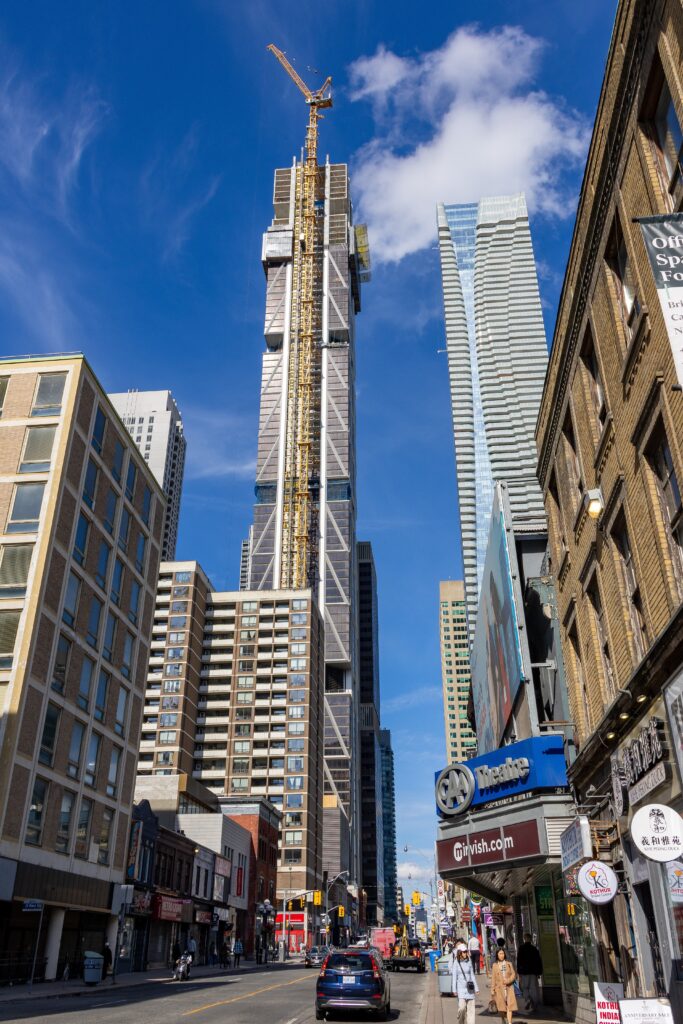
Cover photo: Spadina Avenue at Richmond Street, May 2026. Photo: Dillan Payne, Wikimedia Commons, CC BY-SA 4.0 (resized).